
Blog
What is epoxy resin and what is it used for?


Epoxy resin is becoming increasingly popular and for good reason, the product is simply so capable of completing a wide variety of projects. Some resins are designed for coating and some for pouring thicker layers, let’s try to understand the differences together.
What is epoxy resin?
Epoxy resin can be used for a wide variety of purposes and requires mixing two suitable components together to use it. After mixing the resin and hardener, a chemical reaction begins, which usually lasts for hours. As a result, the resin changes from a liquid state to a solid state, and heat is released as a byproduct. The ratio of the components is usually 1:1 or 1:2, which helps to cure without creating excessive stress.
Resins with different properties are available and they differ from each other in terms of the length of the chemical reaction, the durability and UV resistance of the final product, as well as transparency (if important), heat resistance and maximum layer thickness.
-
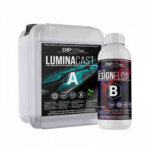 Epoxy Resin LuminaCast 7 Design Flow
Price range: 25.40 € through 72.00 € inc. VAT
Epoxy Resin LuminaCast 7 Design Flow
Price range: 25.40 € through 72.00 € inc. VAT
-
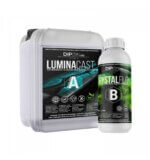 Epoxy Resin LuminaCast 3 Crystal Flow
Price range: 23.75 € through 70.00 € inc. VAT
Epoxy Resin LuminaCast 3 Crystal Flow
Price range: 23.75 € through 70.00 € inc. VAT
-
 ART PRO – transparent epoxy resin for artists
41.70 € inc. VAT
ART PRO – transparent epoxy resin for artists
41.70 € inc. VAT
To find the right epoxy resin for you, you need to pay attention to some aspects:
- Viscosity (flowability)
- Maximum layer thickness per casting process
- Duration of the solidification process
- Adhesion properties on various materials and surfaces
- Hardness after curing is complete
What is epoxy resin used for?
Epoxy resin is a very versatile medium for many different types of arts and crafts projects. The examples below are just a few of the many possible uses:
- Covering living spaces floors
- Covering worktops in the kitchen
- Epoxy resin and wood products , such as cutting boards
- Epoxy resin jewelry
- Quick repair with special UV resin
- Art objects made from epoxy resin, such as resin art pictures
- Casting all kinds of shapes
- Furniture, such as tables made of epoxy resin
- Waterproofing the garage floor
- Casting objects in resin
- Glue
- Boat topcoating
- Covering shower room floors
- Model building
What should you think about when looking for resin?
If you are just starting out with epoxy resins, the price of many resins can be a bit overwhelming at first. But that shouldn’t be the reason you should always go for the cheapest deal. Especially the cheaper options can sometimes be of such poor quality that they can put you off trying anything.
For example, some products may also contain solvents that are harmful to health or evaporate during the curing process . It may then happen that your material does not harden completely or is difficult to mix beforehand. Some cheap resins do not impress with their crystal-clear transparency, but already look slightly yellowish during processing. This unpleasant yellow tint can later become significantly stronger when exposed to sunlight.
Tip: Despite the different prices, you should buy high-quality components whenever possible to achieve beautiful results.
Which resin is best for your project?
The main thing is to know what the resin will be used for. Then, you can filter out the options for yourself, choosing the one that has the most similar properties given by the manufacturer.
Low viscosity (liquid) resins for thick casting
The property of having an almost water-like consistency can be very important in some projects, such as when you want to pour molds or make river boards.
These resins cure very slowly, so there is a lot of time for processing. Low viscosity epoxy resins usually only cure after 12-24 hours because the exothermic process occurs so slowly, so relatively little heat is released. In contrast to high viscosity or medium viscosity epoxy resins, thicker layers and larger quantities can be poured with these resins without any problems.
Areas of use
- Casting into all kinds of molds
- Epoxy resin jewelry
- Model making
- Furniture, such as tables made of epoxy resin
- Filling cracks and holes in wood
- Covering floors in living spaces and garages
High viscosity resins for coating
Many thicker and therefore very viscous or medium viscosity epoxy resins resemble honey in their consistency. Resins in this category are particularly suitable for coating surfaces. They can also be used in the field of resin art. For very viscous resins, you should take the manufacturer’s information on the maximum layer thickness seriously. In many cases, the layer thickness should not exceed 1-2 cm!
Applications of coating resins
- Resin art, casting images with resin
- Decorative items
- Finishing of all types of paintings and artworks
- Epoxy resin jewelry
- Covering worktops and tables
Information about different viscosities
Layer thickness
Since low viscosity resins heat up less during curing, they can be poured in thicker layers. You can remove air bubbles from a still liquid epoxy resin layer with a heat gun or gas torch.
More viscous coating resins should not be poured more than 1 cm at a time, as bubbles will have a much harder time coming to the surface due to their thickness.
Tip: You can usually find the most important information on the product packaging. As a rule, this information should also indicate the total amount of material that can be used in one operation without any problems.
Pot life
A very important factor when working with epoxy resins is the so-called processing time, also called pot life or open time. These terms describe the period of time during which the resin can be processed after the two components (resin and hardener) are mixed together.
At a certain point, the final stage begins, where the resin becomes thicker and more viscous. After this point, the resin should not be processed any further (except perhaps in special cases) as it is no longer self-leveling.
Short processing time
Good
Errors
Long processing time
Good
Errors
Curing time
The curing time of an epoxy resin is the time it takes for the components to reach their full hardness and durability after mixing. The curing time is usually also related to the processing time: if the processing time is short, the resin will usually be fully cured in a relatively short time.
How much do products differ in processing time?
- Products with a short working time – about 20 minutes to 1 hour – should fully cure in about 24 hours.
- Products with a working time of up to 12 hours require up to 1 week to fully cure.